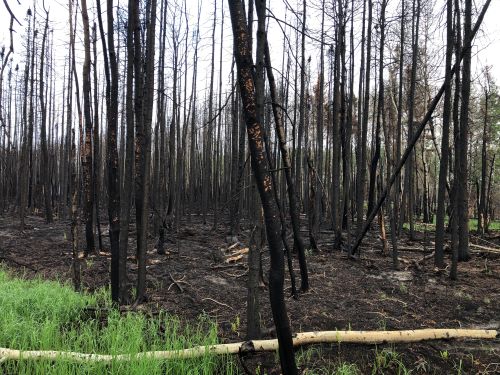

Wildfires pose a growing risk to farms, acreages, communities, and infrastructure in agricultural landscapes across Alberta. The 2025 Canadian wildfire season—one of the worst on record—resulted in an estimated $6 billion in economic losses, with wildfire-related insurance claims rising sharply and contributing to higher premiums and reduced insurability in high-risk areas.
As climate change intensifies fire seasons through prolonged drought, higher temperatures, and increased wind events, proactive vegetation(trees, shrubs and grass) management has become essential to wildfire mitigation. Proper pruning and removal of trees and shrubs are among the most effective practices, reducing fire intensity, limiting vertical and horizontal fire spread, and improving defensible space around structures and infrastructure.
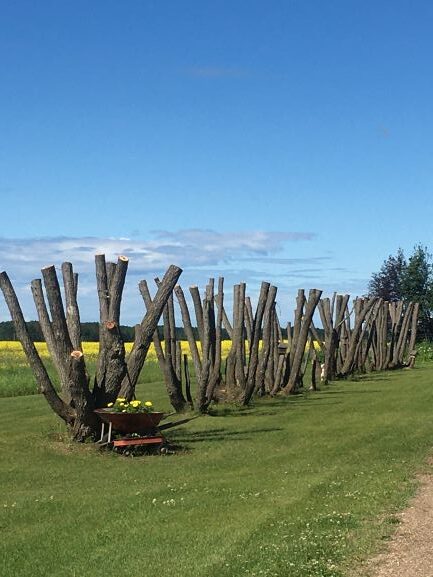
Woodlots, shelterbelts, and windbreaks are integral to farms, ranches, acreages, and communities, providing wind protection, snow control, soil conservation, and improved crop productivity. However, without proper design and maintenance, they can act as continuous fuel corridors that increase wildfire risk. However, if not properly designed and maintained, they can also increase wildfire risk by acting as continuous fuel corridors that allow fire to spread rapidly toward farmyards, buildings, and communities. Pruning, thinning and tree removal during the dormant season is part of wildlife risk reduction. Perform fire hazard assessment for entire your property is strongly recommended.
Tree/forest pruning and thinning
Pruning and forest thinning for fire hazard reduction purposes are not aesthetic maintenance practices but strategic fuel-reduction measures aimed at modifying vegetation structure to reduce ignition potential and slow wildfire behavior. The primary objective of pruning is to reduce ladder fuels—vegetation that enables surface fires to climb into tree canopies, where fires become more intense, fast-moving, and difficult to control. Proper pruning increases vertical separation between ground fuels and the live canopy, lowering the risk of crown fire initiation while removing dead, dry, and low-hanging branches that readily ignite from embers or radiant heat.
Selective forest thinning and removal in woodlot and dense shelterbelts focuses on reducing stand density to break up continuous fuels that allow rapid fire spread. When trees are overcrowded, flames can easily transition from the forest floor into the canopy, resulting in extreme fire behavior. Thinning increases spacing between trees, further reduces ladder fuels, and improves overall fire resilience. Additional benefits include enhanced access for firefighting operations and opportunities for trail or access road development.
Timing for pruning and thinning
Pruning and thinning are best conducted during the dormant season, typically from late fall to early spring, when trees are less biologically active. Dormant-season work reduces stress, limits the spread of insects and pathogens, and allows pruning wounds to respond more effectively once growth resumes. Winter conditions also improve visibility of tree structure, making it easier to identify ladder fuels, deadwood, and hazardous branches, while frozen ground minimizes soil compaction and root disturbance.
Pruning and thinning should be avoided during early spring when dry, low humidity, strong windy conditions and cured fine fuels significantly increase wildfire ignition risk. During early spring, fine fuels such as dry grasses, leaf litter, and conifer needles are often fully cured, while soil and vegetation moisture remain low following winter snowmelt. These conditions create a highly receptive fuel bed where even a small spark can ignite a wildfire. Chainsaws, pruners, brush cutters, and motorized equipment can easily generate sparks capable of starting fires under these conditions.
Lots of things can go wrong during pruning and tree removal operations which is physically demanding but also inherently hazardous, making safety essential. Pruning and thinning should be carried out by trained and qualified professionals, particularly in forested and wildland–urban interface environments. Strict safety protocols are critical, as this work often involves dead or defective trees, large trees, elevated work, weather conditions, use of various equipment, and operations near structures or utilities and safety is paramount.
Recommendations for pruning and forest thinning
Pruning must be guided by arboricultural best practices to ensure tree health is maintained while wildfire risk is reduced. Improper or excessive pruning can weaken trees, increase stress, and make them more susceptible to pests, disease, and environmental damage. The focus should be on removing dead, dying, damaged, and low-hanging branches, particularly those within the lower portion of the crown. In forested settings, pruning should generally not exceed one-third of the live crown to avoid physiological stress. These are following recommendations:
- Coniferous species—including spruce, pine, fir, juniper, and cedar—generally present a higher wildfire risk due to resinous needles, dense crowns, and low branch retention. Pruning should focus on removing lower branches and selectively reducing crown density while avoiding excessive canopy openings that may increase wind exposure.
- Deciduous species—such as aspen, poplar, maple, ash, oak, linden, and birch—are typically less flammable due to higher moisture content and leaf structure. Nevertheless, pruning remains important to remove deadwood and reduce ladder fuels, particularly where deciduous trees are adjacent to conifers or structures.
- Prune branches to a height of 2–3 meters above ground level.
- In shelterbelts, prune internal dead branches between tree rows to improve tree health and reduce fuel load.
- Maintain short grass around shelterbelts to minimize the risk of fire spreading into trees.
- In areas with very high fire hazard, tiling around shelterbelts may be undertaken as an additional fire-prevention measure.
- In dense, continuous coniferous forests, maintain a minimum spacing of 3 meters between trees; greater spacing may be required in high-risk areas.
- Remove all pruned branches, debris, and logs from the site.
- Contact the power provider to carry out pruning near or under powerlines.
- Consider phased linear removal of overgrown, mature shrub rows with many dead stems. For example, in a 100-foot shrub row, removing approximately 30 feet per year can reduce fire risk while allowing for shrub rejuvenation
- Caragana, commonly used in shelterbelts and windbreaks across Alberta, is very flammable shrubs and can pose significant wildfire risk if not properly managed. Its dense growth habit, fine branching, and tendency to accumulate dead material create highly flammable fuel, particularly during drought conditions.
- All combustible vegetation near structures should be minimized or preferable removed. Trees should not have branches overhanging roofs, chimneys, or decks, and shrubs should be pruned or removed entirely. Any retained trees must be well-maintained, with no deadwood and clear separation from buildings.
- Area that are 1.5–10 meters from structures requires pruning to eliminate ladder fuels and reduce canopy density. Branches should be raised to prevent flame contact with crowns, and spacing between trees should be increased. Shrubs and lower vegetation should be kept well below the lowest live branches.
- In area 10–30 meters and beyond structures , pruning is typically less intensive but thinning is still essential. The focus is on removing dead material, reducing ladder fuels, and maintaining tree health while preserving natural forest structure. Pruning and thinning in this zone helps slow fire spread and reduces ember production.
- Hire professional arborist and tree/forest removal companies for pruning and tree removal work.
- Contact local fire department to perform fire hazard assessments for your community or farm
Resources
FireSmart Alberta provides excellent resources for landowners, farmers, homeowners, communities, and other land users. All land users are strongly encouraged to use these resources as part of their home, farm, and community planning and implementation.