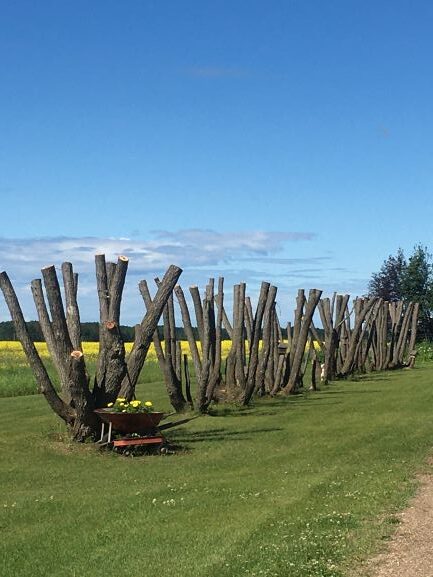

Tree topping, sometimes referred to as “heading,” “dehorning,” or “hat-racking,” drastically alters a tree’s natural form by removing the upper canopy without regard to branch structure or biological function. After more than two and a half decades of professional practice and delivering hundreds of educational pruning workshops, it is still common to see that tree topping continues to be practiced across Alberta. Despite extensive outreach and industry guidance discouraging this harmful technique, it remains common for several recurring reasons.
On private properties, tree topping is commonly requested to reduce tree height, lower perceived maintenance costs (although in reality topping significantly increases long-term maintenance expenses), improve sunlight penetration, reduce fear of storm damage, enhance views, or create certain “decorative” landscape features. In some instances, topping is performed to remove branches encroaching from a neighbouring tree which further can create legal issues, or simply as a quick solution to “get the job done to avoid ongoing nagging” .
In rural and small-town settings, topping is often used as a rapid response to conflicts with buildings, signage, overhead utilities, or sightlines. Unfortunately, this work is frequently carried out by individuals advertising themselves as “tree persons” or some local contractors who lack formal arboricultural training and do not follow established pruning standards.
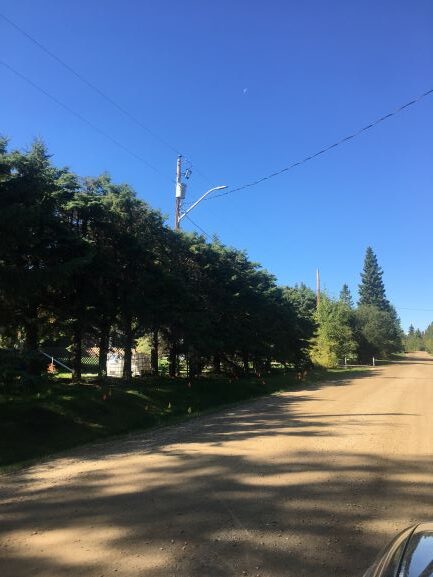
In rural Alberta, tree topping is frequently carried out within shelterbelts situated beneath overhead powerlines. In many cases, this practice is justified as a safety measure intended to prevent electrical interference and reduce perceived fire or outage risks. Best practice is to avoid planting large trees under or near powerlines, instead of large-growing tree species should not be planted beneath or adjacent to overhead utilities. Instead, appropriate low-maturing trees and compatible shrub species should be selected.
Damages
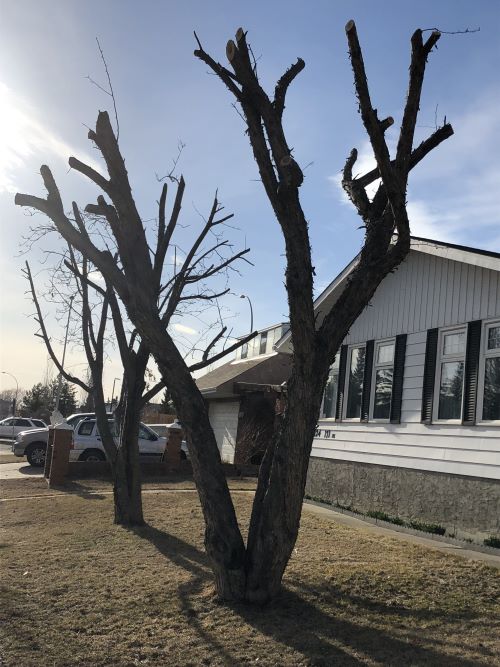
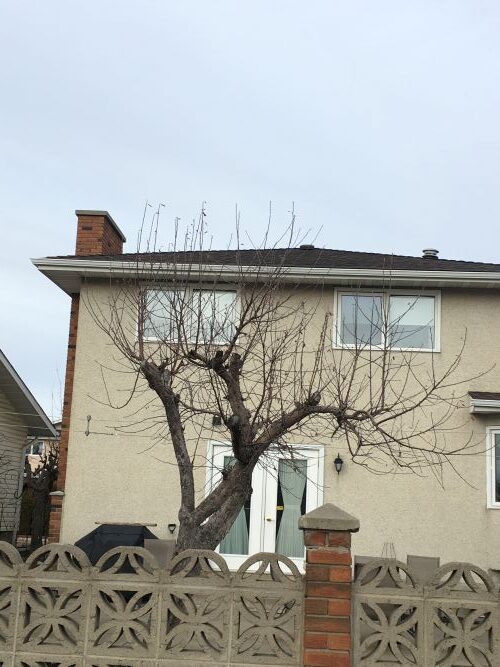
Tree topping is an improper pruning practice that involves the indiscriminate removal of large portions of a tree’s crown, typically by cutting back main stems or large branches to stubs or lateral branches that are too small to assume the terminal role. When topped, deciduous trees grow huge amount of sprouts, while conifers grow competing leaders from side branches. Topping removes a substantial portion of the leaf-bearing canopy, often exceeding 25–50 percent of the tree’s crown in a single operation. There are several long-term damages that occurs as results of tree topping.
Physiological damages– Tree topping causes severe physiological stress. Tree topping involves the indiscriminate removal of substantial portions of a tree’s crown, including large branches and significant leaf area. In extreme cases, nearly all foliage and upper branches are removed, leaving behind prominent stubs at the points where major limbs were cu. Leaves are the primary organs responsible for photosynthesis, and their sudden removal deprives the tree of its ability to produce energy. As results of tree topping, the tree enters a survival mode, rapidly producing numerous weakly attached shoots known as epicormic sprouts or water sprouts. While this regrowth may appear vigorous, it is structurally unsound and biologically inefficient.
Also, the large wounds created by topping cuts further compromise tree health. Because topping cuts are typically too large for the tree to compartmentalize effectively, they become entry points for decay fungi, insects, and pathogens. Over time, internal decay spreads down the stem, weakening the tree’s structural integrity and increasing the likelihood of failure.
Structural and safety risks – One of the most serious consequences of tree topping is increased risk to safety. The epicormic shoots that develop after topping grow rapidly but are poorly attached, originating from shallow tissues near the bark surface rather than from strong branch unions. As these upright sprouts don’t have branch collars, as they mature, they become highly susceptible to breakage during wind, snow, or ice events.
Additionally, the decay associated with topping cuts compromises the load-bearing capacity of stems and branches. Topped trees often become more hazardous than they were prior to pruning, contradicting the original intention of risk reduction.
Increase cost and liability – tree topping increases long-term maintenance costs. The rapid regrowth that follows topping requires frequent pruning to manage shoot length and perceived hazards. Over time, repeated cycles of topping and regrowth accelerate structural decline, often resulting in premature tree removal. When decay and structural instability become severe, the cost of removal can be significantly higher than that of proper pruning or early intervention. In this sense, tree topping represents a short-term solution that creates long-term liabilities for property owners and municipalities.
Aesthetic and environmental consequences – Tree topping significantly diminishes the natural form and aesthetic value of trees. Mature trees that have taken decades to develop balanced architecture are abruptly reduced to unnatural silhouettes with flat or irregular crowns. The resulting appearance often detracts from landscape quality and property value.
From an environmental perspective, topped trees provide reduced range of ecosystem services. Canopy loss decreases shade, leading to higher surface and air temperatures. Wildlife habitat is disrupted as nesting sites, food sources, and shelter are removed. The reduction in leaf area also limits the tree’s capacity to sequester carbon, filter air pollutants, and intercept stormwater.
Management recommendations
Tree topping is a harmful practice that compromises tree health, increases safety risks, reduces environmental benefits, and leads to higher long-term costs. Avoid any topping practices in first place as there are several effective and tree-friendly alternatives to topping that address common concerns:
- Remove and replace – Under the powerline you may consider tree removal and planting small tree and shrub species that will never reach powerline.
- Consider right tree, right place mindset to avoid future problems with trees. If a tree is too large for its location, it is better to remove it and replace it with a smaller species rather than constantly topping it
- Be safe and don’t perform any tree pruning under powerline, contact your powerline provider for tree pruning and removal. If you need to prune or remove under powerline within your property, you should hire ISA Certified Utility Arborist or powerline provider to perform pruning and removal
- If the height and spread is an issue, perform proper crown reduction pruning that involves selectively reducing the length of branches by cutting back to lateral branches that are large enough to assume the terminal role. This method maintains natural form while reducing height or spread.
- Perform crown thinning, which removes select branches throughout the canopy to improve light penetration and air movement without altering overall tree size or structure
- Perform crown raising which removes lower branches to provide clearance for buildings, vehicles, or pedestrians while preserving the upper canopy
- Learn and educate yourself about tree pruning
- Hire professional arborist to perform proper pruning
Resources
Trees Are Good by ISA provides excellent resources for landowners, homeowners, communities, and other land users.
Find A Certified Arborist – ISA Prairie Chapter – provide list of ISA Certified Arborist
Click Before You Dig – Alberta Utility Safety