The white pine weevil(Pissodes strobi) is insect pests affecting young coniferous trees in shelterbelts, windbreaks and urban settings. In Alberta, it primarily attacks the terminal leaders(current and previous year growth) of mostly white spruce as well as some pine, causing growth deformities, long-term structural weakness (development of forked tops). It can be considering nuisance pest but in many parts of Alberta persistent infestations can diminish the aesthetic, ecological, and economic values especially in tree nurseries settings.
Pest ID and Symptoms
The white pine weevil is a small insect 5–7 mm long, with a distinct elongated snout and mottled reddish-brown to grey body marked with pale scales, which provide camouflage against bark surfaces. Adults overwinter in ground litter and debris, emerging in early spring—often in March and April, even before complete snowmelt—to climb host trees, feed, and lay eggs. Larvae are creamy white, legless grubs with reddish-brown heads, reaching up to 10 mm at maturity. They feed beneath the bark within the terminal leader for approximately 5–6 weeks. New adults emerge in late summer to early fall and then move to protected sites to overwinter. The species completes one generation per year
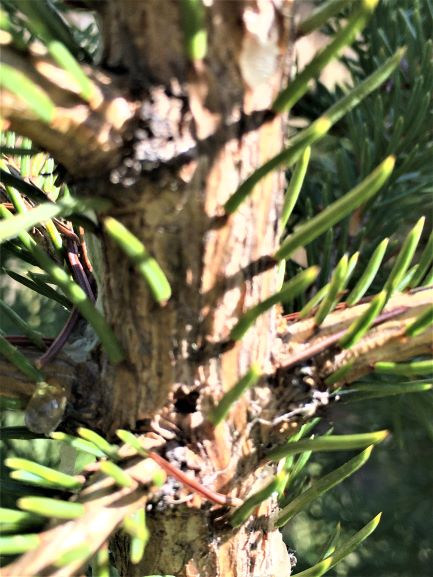
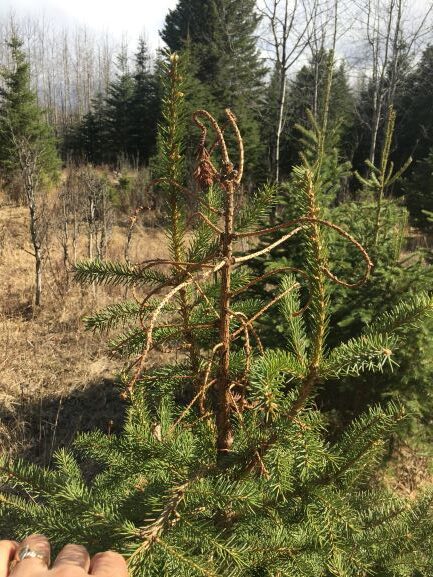
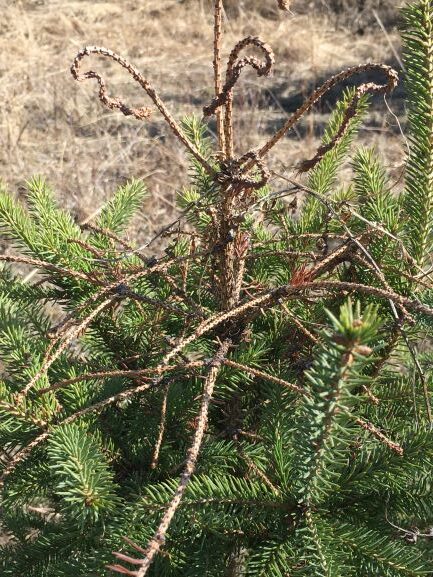
In spring, small puncture wounds and resin droplets may appear on the bark of the current-year leader, indicating adult feeding and oviposition. As larvae develop beneath the bark, internal feeding disrupts vascular tissues, leading to visible wilting and browning of the terminal leader. By early summer, the leader often bends over, forming the characteristic “shepherd’s crook” shape. Peeling back bark from recently killed leaders may reveal white, legless larvae or pupae within the stem.
Damage
The most distinctive symptom of white pine weevil infestation is the “shepherd’s crook” appearance of the terminal leader. As larval feeding disrupts vascular tissues, the leader wilts, bends, and turns brown. By early summer, the leader dies back, leaving the tree without a dominant central stem. A single infestation can kill at least two years of terminal leader growth. Loss of the terminal leader results in multiple lateral branches competing to become the new leader, producing crooked stems, forked tops, and weak branch attachments.
White pine weevil preferentially attacks young, open-grown trees in full sun. Trees under 6–8 m(under 30 feet) tall with vigorously growing leaders are most susceptible, while attack rates decline significantly as trees mature, typically after 20 years. As a result, this pest poses the greatest risk in open shelterbelts, windbreaks and reforestation sites, Christmas tree plantations, and nurseries. Repeated infestations can severely stunt growth and predispose trees to secondary pests, decay fungi, and mechanical failure.
Management and Control
Effective management on trees involves an integrated approach, combining cultural, biological, and maybe some chemical control methods:
- Avoid planting monoculture of spruce trees. Promoting species diversity is one of the most effective long-term strategies for reducing white pine weevil impact.
- Regular visual inspections of terminal leaders’ scars, resin droplets and small hole helped detect weevil outbreaks early. Keep trees healthy.
- Pruning and destroying infested leaders before adult emergence is most effective method to reduce local populations
- Insecticide applications may be warranted in high-value ornamental plantings and tree nurseries. Insecticide control are expensive and treatments must be precisely timed to coincide with adult feeding and egg-laying in early spring which are very weather dependent.
- Natural enemies including parasitic wasps, predatory insects, and birds, contribute to population regulation but rarely provide sufficient control in high-risk settings